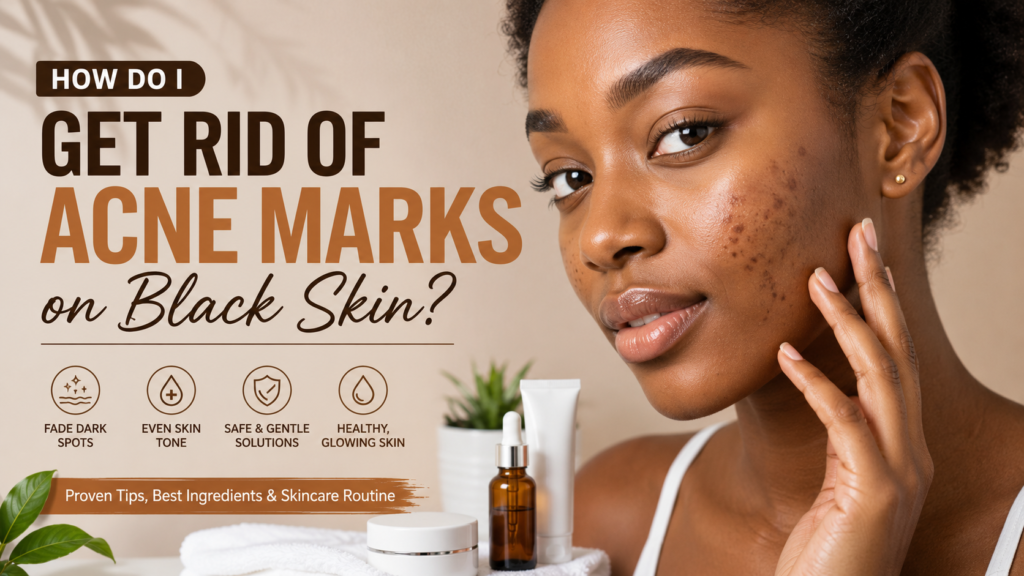
Some mornings, I look in the mirror and think, “The pimple is gone… so why is it still hanging around?” Then I realise it’s not the acne anymore—it’s the mark it left behind, almost like an unwanted souvenir. If you’ve ever felt the same, trust me, you’re not alone.
One thing I’ve learned is that getting rid of acne marks on Black skin takes patience, not magic. Our melanin-rich skin is beautiful, but it also reacts differently after inflammation. Even a small breakout can leave behind dark spots that seem determined to stay longer than the acne itself.
The good news? They don’t have to stay forever.
- Can Cocoa Butter Remove Dark Spots? Here’s What I Found
- Best Body Wash for Hyperpigmentation on Black Skin
- Which Body Lotion Is Best for Glowing Black Skin?
- How Do I Get Rid of Acne Marks on Black Skin?
- Which Skincare Routine Is Best for Melanin-Rich Skin?
Why Does Black Skin Get Acne Marks So Easily?
When acne causes inflammation, my skin naturally produces extra melanin as it heals. That extra pigment creates dark spots known as post-inflammatory hyperpigmentation (PIH).
This isn’t a scar in most cases. It’s simply an area where my skin made more pigment during the healing process.
The temptation is always there to squeeze or pick at pimples. I’ve learned that every time I do, I’m practically sending an invitation for darker, longer-lasting marks. My fingers are not skincare tools—I’ve finally accepted that.
How Do I Get Rid of Acne Marks on Black Skin?
After trying different routines and reading advice from dermatologists, I found that consistency beats expensive products every time.
1. Wear Sunscreen Every Day
This surprised me.
For years, I believed Black people didn’t really need sunscreen. Wrong.
UV rays can make acne marks darker and slow the fading process, even on cloudy days. Now I use a broad-spectrum SPF 30 or higher every morning.
Think of sunscreen as giving your skin a fair chance to heal instead of making it fight the sun at the same time.
2. Use Niacinamide
Niacinamide quickly became one of my favourite skincare ingredients.
It helps fade dark spots, strengthens the skin barrier, controls excess oil, and calms redness. Better yet, it’s gentle enough for most skin types.
If you’re wondering how to get rid of acne marks on Black skin, niacinamide is one ingredient I would definitely put near the top of the list.
3. Add Vitamin C Carefully
Vitamin C can brighten dull-looking skin and gradually reduce pigmentation.
I usually apply it in the morning before moisturizer and sunscreen. It doesn’t work overnight, but after several weeks, I noticed my complexion looked more even.
Slow and steady wins this race.
4. Try Gentle Chemical Exfoliation
Instead of using rough scrubs that leave my face feeling like it lost a fight, I prefer gentle exfoliating acids.
Ingredients like:
- Lactic acid
- Mandelic acid
- Glycolic acid (used carefully)
- Azelaic acid
help remove dead skin cells so newer, healthier skin can appear.
I never exfoliate every day because irritated skin often creates even more pigmentation.
5. Moisturize Every Single Day
Healthy skin heals faster.
A good moisturizer keeps my skin barrier strong and reduces irritation from active ingredients. I look for products containing ceramides, glycerin, or hyaluronic acid.
Hydrated skin simply behaves better.
Ingredients I Personally Avoid
Not everything advertised as a “brightening cream” is actually good for melanin-rich skin.
I stay away from products that promise instant whitening or unrealistic results in a few days.
Some products may contain harmful ingredients such as:
- Mercury
- Unlisted steroids
- Unknown bleaching agents
Healthy skin should look brighter and more even—not lighter than its natural colour.
How Long Does It Take?
This is the part nobody likes hearing.
Most acne marks don’t disappear in a week.
Depending on how dark the marks are, I usually expect noticeable improvement within 6 to 12 weeks when I’m consistent with my routine.
Older spots can take several months.
I’ve learned that changing products every two weeks usually slows progress instead of speeding it up.
Should I See a Dermatologist?
If my acne marks are getting worse, not fading after several months, or I’m dealing with painful cystic acne, I’d rather see a dermatologist than keep guessing.
Prescription treatments or professional procedures can sometimes make a huge difference, especially for stubborn pigmentation.
My Simple Daily Routine
Morning:
- Gentle cleanser
- Vitamin C or niacinamide
- Moisturizer
- SPF 30+ sunscreen
Evening:
- Gentle cleanser
- Niacinamide or azelaic acid
- Moisturizer
Two or three nights a week:
- Gentle chemical exfoliant instead of other active ingredients
Keeping the routine simple has actually given me better results than filling my bathroom shelf with products I barely use.
Final Thoughts
If you’re asking yourself, ” How do I get rid of acne marks on Black skin?”, remember that fading dark spots is a marathon, not a sprint. I’ve learned that patience, daily sunscreen, the right ingredients, and resisting the urge to pick at pimples make a much bigger difference than chasing miracle creams.
Your skin doesn’t need perfection—it needs consistency. Give it time, treat it kindly, and one day you’ll catch your reflection and realise those stubborn marks have quietly packed their bags and left.